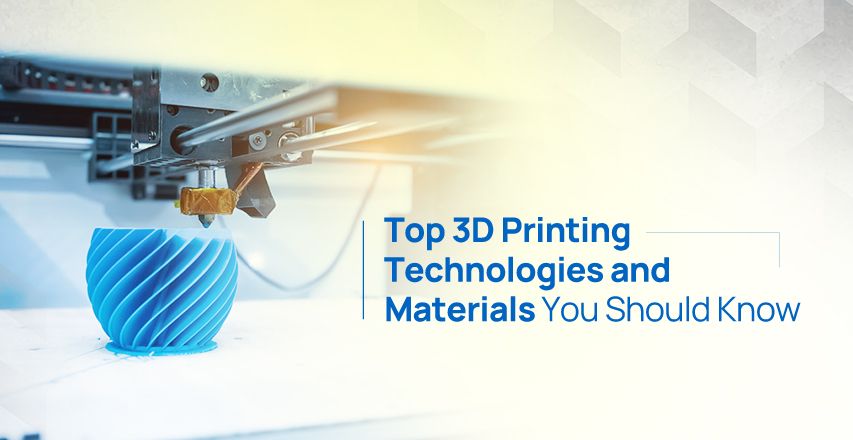
Ad-Line Media, a leader in Design & Fabrication, is interested in staying in front of 3D printing as it is a new technology that is experimenting with creative and contemporary solutions.
Understanding the various materials and technologies that enable 3D printing is essential if you're new to it or want to learn more about its potential. This will help you in picking the most suitable 3D printing technologies and materials suitable for your design, prototyping, or production purposes. Hence, we shall discuss some of the most common and widely used ones in this blog.
Top 3D Printing Technologies
Fused Deposition Modelling (FDM)
FDM is easily one of the most prevalent and available 3D printing technologies available today. This technology utilises heated and extruded thermoplastic filament to deposit it in layers until a model is built.
Why It’s Popular:
- Affordable and widely used.
- Great for prototyping and basic functional parts.
- Compatible with a variety of materials like PLA, ABS, and PETG.
Best For:
Consumer-grade models, product prototypes, and low-cost production.
Stereolithography (SLA)
The process of SLA involves layer-by-layer curing of resin by a laser. With this process, parts with high resolution and smooth surfaces can be produced.
Why It’s Popular:
- Exceptional detail and accuracy.
- Ideal for intricate or small designs.
- Excellent surface finish with minimal post-processing.
Best For:
Dental and medical models, jewellery, and artistic miniatures.
Selective Laser Sintering (SLS)
In selective laser sintering, powdered materials are sintered into solid objects using a laser. SLS printing is most commonly done using nylon. SLS does not require support structures because the other powder, surrounding the part, will hold it in place.
Why It’s Popular:
- Durable and functional prototypes.
- No need for support structures.
- Can produce complex geometries with ease.
Best For:
Industrial components, aerospace parts, and functional prototypes.
Most Common 3D Printing Materials
Choosing the right material is just as crucial as choosing the right technology; each material has advantages and disadvantages and might be suitable for a given application.
Polylactic Acid (PLA)
Unlike non-biodegradable thermoplastics, PLA is biodegradable and derived from renewable resources like corn starch or sugar cane. It is excellent for newcomers and may be among the simplest materials to work with!
Key Features:
- Environmentally friendly.
- Low warping and odour.
- Not suitable for high-temperature environments.
Used In:
Concept models, educational projects, and decorative items.
ABS (Acrylonitrile Butadiene Styrene)
Due to its high impact strength and toughness, it is commonly used in industrial and consumer applications.
Key Features:
- High strength and durability.
- Heat resistant.
- To avoid warping, it is essential to heat the print bed.
Used In:
Functional parts, automotive components, and consumer electronics.
Resin
Used primarily in SLA and DLP (Digital Light Processing) printing, resins offer fine detail and a smooth finish but may be brittle depending on the formulation.
Key Features:
- High-detail finish.
- Suitable for intricate and aesthetic models.
- Needs post-curing and handling precautions.
Used In:
Jewellery casting, dental models, and miniature figurines.
Nylon (Polyamide)
Popular with SLS printing, nylon is robust, strong, and can stand up to wear.
Key Features:
- Strong yet lightweight.
- Great for interlocking parts and mechanical components.
- Slightly porous finish.
Used In:
Functional prototypes, hinges, enclosures, and gears.
The Future of 3D Printing: Customisation Meets Innovation
3D printing is still a user-driven tool that, as companies strive for quicker prototyping and achieve more bespoke solutions, will always find its way into design and production. At Ad-Line Media, we still utilise this technology, providing creative and agile designs for exhibitions, product conceptual models, branding props, etc.
Whether you are an artist, an engineer, an architect or an entrepreneur, understanding the right combination of 3D printing technologies and materials can help enhance your creative possibilities, empowering your creativity, while also reducing your production.
Partner with Ad-Line Media for Your 3D Printing Needs
At Ad-Line Media, we turn ideas into reality. Our team of designers and fabricators helps our clients stay ahead of the competition from concept to completion by offering end-to-end 3D printing and fabrication solutions.
Do you wish to bring concepts to life? To learn how 3D printing can elevate your upcoming project, get in touch with Ad-Line Media!